
Do you want to learn Artificial Intelligence and looking for an Artificial Intelligence Learning Roadmap [AI Roadmap]?… If yes, this article is for you. In this article, you will find a step-by-step Roadmap to learn Artificial Intelligence for 2026.
You’ve probably seen ten different roadmaps that all tell you something different. Some start with math, some throw you straight into ChatGPT, some are five years out of date. So which path actually works now?
I’m an ML researcher and PhD scholar, and I’ve watched this field change fast, especially in the last two years. The roadmap that worked in 2022 is not the roadmap for 2026. Big data and business intelligence used to sit near the top of every AI path. Now the center of gravity has moved to generative AI, LLMs, and AI agents. So I rebuilt this roadmap around how AI is actually learned and used today.
So here’s the short version before the detail.
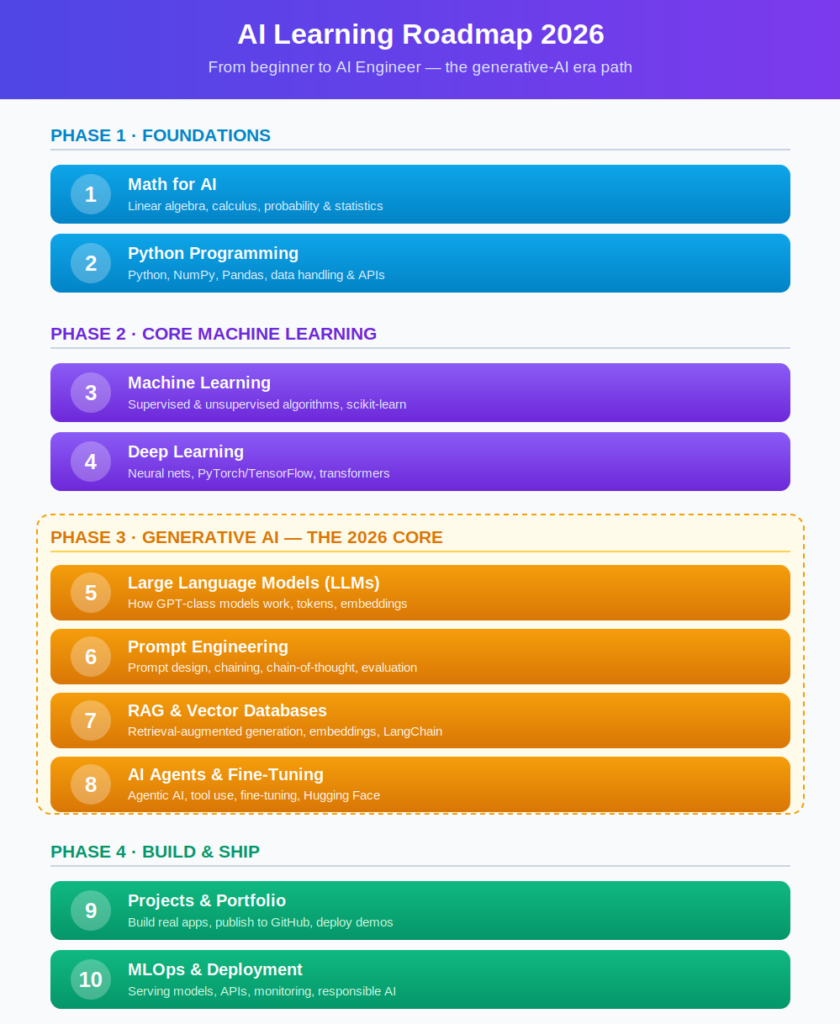
To become an AI engineer in 2026, you follow four phases. First, foundations: math and Python. Second, core machine learning: ML algorithms and deep learning. Third, and this is the new heart of it, generative AI: large language models, prompt engineering, RAG, and AI agents. And fourth, you build real projects and learn to ship them. Big data and business intelligence are optional side-tracks now, not core steps. That reordering is the single biggest thing that’s changed.
So, without further ado, let’s start the Artificial Intelligence Learning Roadmap [AI Roadmap].
Artificial Intelligence Learning Roadmap 2026/AI Engineer Roadmap For Beginners
- Step 1. Learn the math for AI
- Step 2. Learn Python
- Step 3. Learn machine learning
- Step 4. Learn deep learning
- Step 5. Learn large language models (LLMs)
- Step 6. Learn prompt engineering
- Step 7. Learn RAG and vector databases
- Step 8. Learn AI agents and fine-tuning
- Step 9. Build real projects and a portfolio
- Step 10. Learn MLOps and deployment
Below is the full Artificial Intelligence Learning Roadmap, step by step, with the exact skills, the order I’d follow, and the courses I’d point you to for each part.
The Artificial Intelligence (AI) Learning Roadmap at a glance
Before we go deep, here’s the whole path in one look, so you can see where you’re headed.
| Phase | Steps | What you learn |
|---|---|---|
| 1. Foundations | Math, Python | Linear algebra, calculus, stats, Python + data libraries |
| 2. Core ML | Machine Learning, Deep Learning | Algorithms, neural nets, PyTorch/TensorFlow, transformers |
| 3. Generative AI ★ | LLMs, Prompt Engineering, RAG, AI Agents | The 2026 core, building with modern AI |
| 4. Build & Ship | Projects, MLOps | Real apps, portfolio, deployment, responsible AI |
Optional side-tracks: Big Data, Business Intelligence, Computer Vision, NLP depth. Useful for specific jobs, not required to start.
So you don’t have to do all of this at once. You go phase by phase, and you can start building useful things by the end of Phase 3. Now let me break down each step.
Phase 1: Foundations
Step 1. Learn the math for AI
So do you need heavy math to start? Honestly, less than people scare you into thinking. You don’t need a math degree. But you do need the core ideas, because they’re what turn machine learning from hard part into something you understand.
Focus on three areas. Linear algebra, because vectors and matrices are how data and models are represented. Calculus, mainly derivatives and gradients, because that’s how models learn. And probability and statistics, because that’s how models handle uncertainty and how you evaluate them.
You don’t need to master all of it before moving on. Learn the basics, then come back and deepen it as you hit each topic. That’s how I did it, and it’s far less painful than trying to finish all the math first.
You’re ready to move on when you can explain what a vector and a matrix are, what a derivative tells you, and what mean, variance, and a probability distribution mean, without panicking. You don’t need to solve hard problems by hand. You need to not be scared of the notation.
Where to learn it:
- Intro to Statistics– Udacity FREE Course
- Basic Statistics (Online Course)
- Statistics and probability (Khan Academy)
- Practical Statistics for Data Scientists (TextBook)
- Data Science: Statistics and Machine Learning Specialization (Online Course)
- Statistics for Data Science (YouTube Video)
- Mathematics for Data Science Specialization (Online Course)
- Khan Academy
- Data Science Math Skills (Online Course)
Step 2. Learn Python
Python is the language of AI, so this one’s non-negotiable. The good news is it’s beginner-friendly and you don’t need to become a software engineer, you need enough to work with data and models.
Learn the basics of Python first, then the data libraries: NumPy for numerical work, Pandas for handling data, and Matplotlib for visualizing it. Get comfortable pulling in a dataset, cleaning it, and poking around. That skill alone carries through the entire roadmap.
Tools for this step: Python, Jupyter or Google Colab, NumPy, Pandas, Matplotlib.
Your first project: grab any free CSV dataset (Kaggle has thousands), load it in Pandas, clean the missing values, and make three charts that tell you something about it. You’re ready to move on when you can do that without copying every line from a tutorial.
Where to learn it:
- MLTUT FREE Python Course (YouTube)
- Introduction to Python Programming(Udacity Free Course)
- The Python Tutorial (PYTHON.ORG)
- CS DOJO (YouTube)
- Python 3 Tutorial (SOLOLEARN)
- Python For Data Science(Udemy)
- Programming with Mosh (YouTube)
- Corey Schafer (YouTube)
Phase 2: Core machine learning
Step 3. Learn machine learning
Now the real part starts. Machine learning is where you learn how models actually find patterns in data. Start with the concepts, then the main algorithm families.
Cover supervised learning (regression, classification), unsupervised learning (clustering, dimensionality reduction), and the core algorithms like linear and logistic regression, decision trees, random forests, and gradient boosting. And learn how to evaluate a model properly, train-test splits, overfitting, cross-validation, because knowing when your model is lying to you is half the job.
You’ll do all this with scikit-learn, the standard Python ML library. Don’t just watch, build small models on real datasets as you go. That’s what makes it stick.
Tools for this step: scikit-learn, Pandas, Jupyter/Colab.
Your project: build a model that predicts something real, house prices from a housing dataset, or survival on the Titanic dataset (the classic beginner one). Split your data properly, train a couple of algorithms, and compare them. You’re ready to move on when you understand why your model scores what it scores, and you can spot overfitting when it happens.
Where to learn it:
- Introduction to Machine Learning with TensorFlow(Udacity)
- Introduction to Machine Learning Course(Udacity Free Course)
- Machine Learning: Unsupervised Learning (Udacity)
- Machine Learning by Stanford University(Coursera)
- Machine Learning for All by University of London(Coursera)
- What is Machine Learning? (Udemy)
- Machine Learning Fundamentals(edX)
Step 4. Learn deep learning
Deep learning is the engine behind modern AI, including everything in the generative AI phase next. So this step is the bridge.
Learn how neural networks work, then the main architectures: CNNs for images, RNNs for sequences, and most importantly, transformers, because transformers are the foundation of every large language model you’ll build with later. Pick one framework and get comfortable, PyTorch is the most common in research and increasingly in industry, though TensorFlow is still widely used.
Understanding transformers is the thing that connects this phase to the next. Once you get how attention works, LLMs stop being a mystery and start being something you can actually reason about.
Tools for this step: PyTorch (recommended) or TensorFlow, plus Hugging Face for pre-trained models.
Your project: build an image classifier with a CNN (the MNIST digits or a cats-vs-dogs dataset are the standard starts), then read one clear explanation of the transformer architecture and make sure you can describe, in your own words, what attention does. You’re ready to move on when transformers feel like a thing you understand, not a buzzword.
Where to learn it:
- Deep Learning Specialization (deeplearning.ai)
- Deep Learning– Udacity
- Intro to Deep Learning with PyTorch– Udacity FREE Course
- Intro to TensorFlow for Deep Learning– Udacity FREE Course
- Intro to Deep Learning– Kaggle
- Generative Adversarial Networks (GANs) Specialization– Coursera
- Become a Deep Reinforcement Learning Expert– Udacity
- Deep Learning: Convolutional Neural Networks in Python– Udemy
- Reinforcement Learning– Udacity
- Neural Networks and Deep Learning– Coursera
Phase 3: Generative AI: the 2026 core
So this is the part that’s completely changed the roadmap, and it’s where most old guides fall behind. In 2026, generative AI isn’t an advanced afterthought at step 8. It’s the center of what AI engineers actually build. So I’ve moved it up, and I’d tell you to treat this phase as the main event.
Step 5. Learn large language models (LLMs)
Large language models like the GPT family, Gemini, and Claude are the backbone of modern AI applications. You don’t need to train one from scratch, almost nobody does. You need to understand how they work and how to build with them.
Learn what tokens and embeddings are, how a model generates text, what context windows mean, and what these models are good and bad at. Then get hands-on with an API, calling an LLM from Python and getting structured output back is the foundational skill of modern AI work.
Go a level deeper than most beginners do. Understand the difference between a base model and an instruction-tuned model, what temperature and top-p do to the output, why context windows have limits and what that means when you feed in long documents, and why models hallucinate. These aren’t trivia, they’re the things that bite you when you start building, so knowing them early saves you real pain.
Tools for this step: the OpenAI, Anthropic (Claude), or Google Gemini APIs, plus Hugging Face for open models like Llama and Mistral. Python to call them.
Your project: build a small command-line tool that takes a long article and returns a summary, a list of key points, and three questions about it, all from one API call with a well-structured prompt. You’re ready to move on when you can call an LLM from Python, control its output format, and explain why it sometimes gets things wrong.
This is also where “roadmap to learn generative AI” really begins, if that’s the specific path you came here for. Everything from here on is the generative AI track.
Where to learn it:
- MLTUT Claude Code FREE Course (YouTube)
- Generative AI with Large Language Models: DeepLearning.AI & AWS
- Generative AI Specialization – DeepLearning.AI
- Complete Generative AI Course with LangChain and Hugging Face– Udemy
- Building with the Claude API– Coursera
- Gen AI Using Hugging Face Training– Coursera
Step 6. Learn prompt engineering
Prompt engineering is how you actually get good results out of these models, and it’s a real skill, not just typing questions. It’s the cheapest, fastest-to-learn, highest-payoff skill in this whole roadmap, so don’t skip it.
Learn to write clear, structured prompts, use techniques like few-shot prompting and chain-of-thought, break big tasks into prompt chains, and evaluate and refine outputs instead of accepting the first thing the model gives you. These techniques carry across every LLM you’ll ever use.
Your project: take a task that a plain prompt does badly, like extracting structured data from messy text, and improve it step by step, adding context, examples, and a required output format, until it works reliably. Keep the before and after. That’s a portfolio piece and a genuinely useful skill. You’re ready to move on when you can reliably get an LLM to do what you want, not what it guesses you want.
Where to learn it:
- Prompt Engineering for ChatGPT– Vanderbilt University
- Prompt Engineering Specialization– Coursera
- ChatGPT Masterclass: The Guide to AI & Prompt Engineering– Udemy
- Getting Started with Generative AI API Specialization– Codio
- The Complete Prompt Engineering for AI Bootcamp (2026)– Udemy
- ChatGPT Prompt Engineering for Developers– Datacamp
- Introduction to ChatGPT– Datacamp
Step 7. Learn RAG and vector databases
So the technique that powers most real-world AI apps today is retrieval-augmented generation, or RAG. It’s how you make an LLM answer using your own documents and data instead of just its training knowledge. So if you want to build AI that actually knows about a specific company, product, or dataset, this is the skill.
So let me actually walk you through what a RAG pipeline contains, because “learn RAG” is too vague to act on. There are five pieces, and you build them in order.
First, you take your documents and split them into chunks. Second, you turn each chunk into a vector using an embedding model, that’s a list of numbers capturing its meaning. Third, you store those vectors in a vector database. Fourth, when a user asks a question, you turn their question into a vector too and search the database for the closest matching chunks. And fifth, you hand those retrieved chunks to the LLM along with the question, so it answers using your data instead of guessing. That’s RAG. Once you’ve built one, it stops being intimidating.
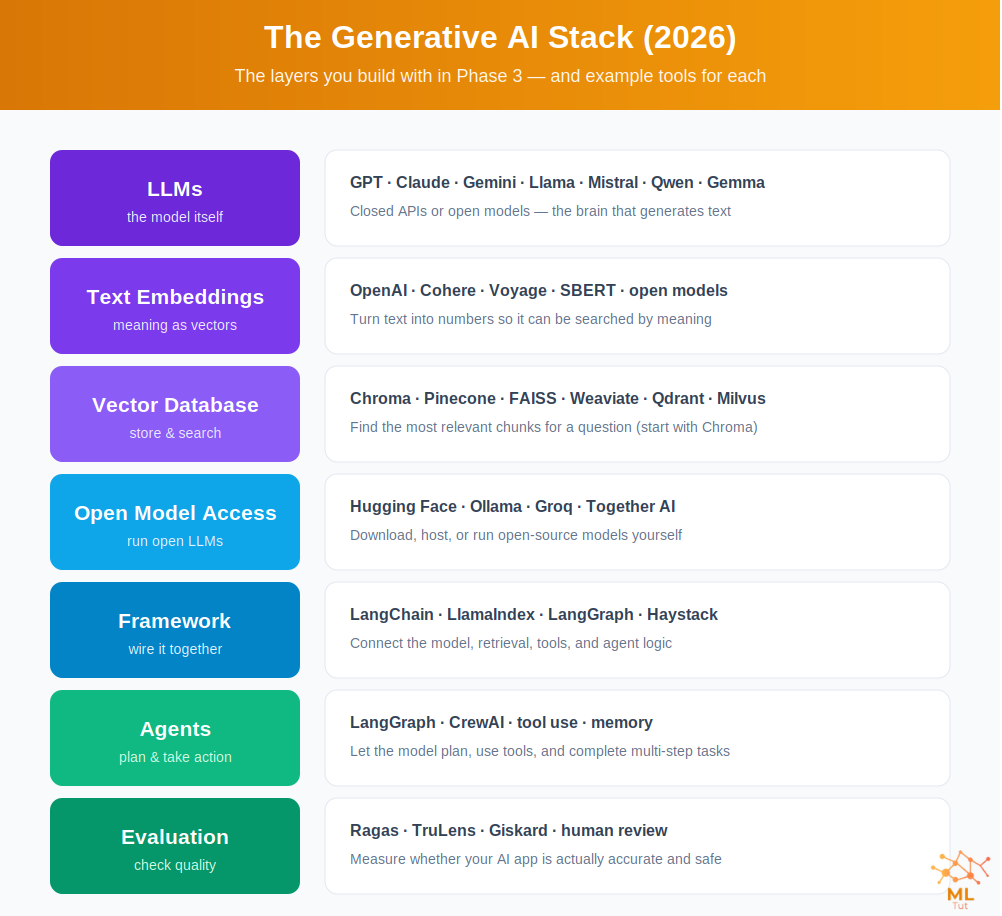
Tools for this step: an embedding model (OpenAI, Cohere, or an open one from Hugging Face), a vector database (Chroma is the easiest to start with, Pinecone and FAISS are common too), and a framework, LangChain or LlamaIndex, to wire it together.
Your project, and make this a good one: build a chatbot that answers questions about your own PDFs. Feed in your lecture notes, a product manual, or a set of research papers, and make it answer only from those documents with sources. This single project is the most impressive thing a beginner can show in 2026, because it’s exactly what companies are hiring people to build. You’re ready to move on when you’ve built a working RAG app end to end and understand each of the five steps.
This is one of the most in-demand AI skills of 2026, and it’s where a lot of the actual jobs are. So spend real time here, more than on any other single step.
Where to learn it:
- MLTUT RAG Basics (YouTube)
- Build a Local RAG App In 26 Minutes (Ollama + ChromaDB + Flask) (YouTube Project)
- Build a Local RAG App with Hybrid Search, Reranking & Memory (Ollama + FastAPI) (YouTube Project)
- Introduction to Retrieval Augmented Generation (RAG)– Guided Project
- Retrieval Augmented Generation by DeepLearning.AI
- Retrieval Augmented Generation Specialization by Packt
- IBM RAG and Agentic AI Professional Certificate
- RAG with LangChain by DataCamp
- Large Language Models and RAG by Udacity
Step 8. Learn AI agents and fine-tuning
This is the newest and fastest-growing part of the field, and it’s completely absent from older roadmaps, which is exactly why adding it puts you ahead.
AI agents (or agentic AI) are systems where an LLM can plan, use tools, and take actions on its own, not just answer a question. So instead of only replying, an agent runs a loop: it thinks about what to do, picks a tool (a web search, a calculator, your database, an API), uses it, looks at the result, and decides the next step, repeating until the task is done.
Learn how that loop works, how agents use tools and memory, and the frameworks that build them, LangGraph and the agent tooling in LangChain are the main ones. This is where a huge amount of 2026’s AI development is heading, so being early here is a real advantage.
Your project: build a simple research agent that takes a topic, searches the web, and writes a short summary with sources, deciding its own steps along the way. It’s the “hello world” of agents and it teaches the whole loop.
Fine-tuning is customizing a model on your own data for a specific task. You won’t always need it, RAG handles a lot, but knowing when and how to fine-tune, and using platforms like Hugging Face, rounds out your toolkit. Hugging Face is worth learning generally, it’s the hub for open models, datasets, and tools.
Where to learn it:
- Agentic AI and AI Agents for Leaders Specialization– Vanderbilt University
- Fundamentals of AI Agents Using RAG and LangChain– IBM
- Multi AI Agent Systems with crewAI– DeepLearning.AI
- AI Agents in LangGraph– DeepLearning.AI
- Udacity Agentic AI Nanodegree
- AI Agent Harness Explained In 18 Minutes (YouTube)
- Build an AI Agent That Organizes Your Files In 13 Minutes (Ollama + Llama 3.2) (YouTube Project)
- Build an AI Chatbot That Works With No Internet (Step by Step) (YouTube Project)
- RAG vs Fine-Tuning: Most People Pick the Wrong One (YouTube)
Phase 4: Build and ship
Step 9. Build real projects and a portfolio
So here’s the honest truth that no course tells you loudly enough: nobody gets hired off certificates. They get hired off projects. So this step counts more than any single course above.
Build things that use what you learned. A RAG app on your own documents. An AI agent that does a real task. A fine-tuned model for something specific. A classic ML project with clean analysis. Put them all on GitHub, write up what you did, and deploy a demo where you can. That portfolio is what turns “I studied AI” into “I can build AI,” and it’s what employers actually look at.
Start building earlier than you feel ready. You learn the most when you’re stuck on your own project, not when you’re following along in a course.
- Build an AI Agent That Organizes Your Files In 13 Minutes (Ollama + Llama 3.2) (YouTube Project)
- Build an AI Chatbot That Works With No Internet (Step by Step) (YouTube Project)
- Build a Local RAG App with Hybrid Search, Reranking & Memory (Ollama + FastAPI) (YouTube Project)
- Build a Local RAG App In 26 Minutes (Ollama + ChromaDB + Flask) (YouTube Project)
- Multi AI Agent Systems with crewAI Project (Coursera)
- Building Your Own Database Agent (Coursera)
- AI Agents in LangGraph (Coursera)
- AI Agentic Design Patterns with AutoGen (Coursera)
Step 10. Learn MLOps and deployment
The last step is what separates someone who can build a model from someone who can put it into the real world. This is MLOps.
Learn how to serve a model behind an API, containerize it (Docker), deploy it to the cloud, and monitor it once it’s live. And learn the basics of responsible AI, bias, safety, and privacy, because in 2026 that’s not optional, it’s part of the job, and increasingly it’s what employers and regulators expect.
You don’t need to master all of MLOps to get hired, but knowing how a model actually reaches users is what makes you a complete AI engineer rather than someone who only works in notebooks.
Where to learn it:
- MLOps (Machine Learning Operations) Fundamentals– Coursera
- Cloud Machine Learning Engineering and MLOps– Coursera
- Open Source Platforms for MLOps– Coursera
- Python Essentials for MLOps– Coursera
- Complete MLOps Bootcamp– Udemy
- MLOps Fundamentals– Udemy
- Azure Machine Learning & MLOps: Beginner to Advance– Udemy
- Machine Learning Engineering for Production (MLOps) Specialization– Coursera
So, that’s all about Artificial Intelligence Learning Roadmap.
What about big data and business intelligence?
You might have noticed I moved big data and business intelligence out of the core path. That’s deliberate, and it’s one of the biggest updates for 2026.
They’re still valuable, but they’re specializations now, not required steps for becoming an AI engineer. If you’re heading into a data-heavy role that works with massive datasets, learn big data tools like Spark. If you’re going toward analytics and dashboards, business intelligence and tools like Power BI or Tableau are worth it, and I’ve written full guides on those. But for the core AI-engineer path, you can build real, impressive AI applications without either. So don’t let them block you at the start, the way old Artificial Intelligence Learning Roadmap did.
Common mistakes I see people make on this roadmap
So I’ve watched a lot of people try to learn AI, and the ones who stall almost always make the same few mistakes. Let me save you from them.
Getting stuck in tutorial hell. This is the big one. You watch course after course and never build anything of your own, so nothing sticks. The fix is simple and uncomfortable: start building before you feel ready. You learn ten times more from being stuck on your own project than from finishing another tutorial.
Over-studying the math. People spend six months trying to master all the math before they touch a model, and they burn out. You don’t need that. Learn the core ideas, start building, and deepen the math when a specific topic demands it. The math makes far more sense once you’ve seen where it’s used.
Skipping projects to “finish” the roadmap. There’s no finishing this artificial intelligence learning roadmap. If you treat it as a checklist to complete before you’re allowed to build, you’ll never build. Start projects from Phase 2 and keep going. Your portfolio is worth more than a completed course list.
Chasing every new tool. This field moves fast, and there’s a new framework every week. Beginners panic and try to learn all of them. Don’t. Learn the fundamentals deeply, pick one tool per job (one vector database, one agent framework), and you’ll pick up the rest fast when you need them. The fundamentals don’t change nearly as fast as the tool names.
Ignoring the generative AI phase because it feels advanced. Some people following older roadmaps grind through classical ML and treat LLMs and RAG as optional extras. In 2026 that’s backwards. The generative AI phase is where the jobs are, so give it the time it deserves, it’s the core, not a bonus.
A realistic timeline: how long does the AI roadmap take?
So how long does all this take? Honestly, it depends on your background and hours, but here’s a realistic frame.
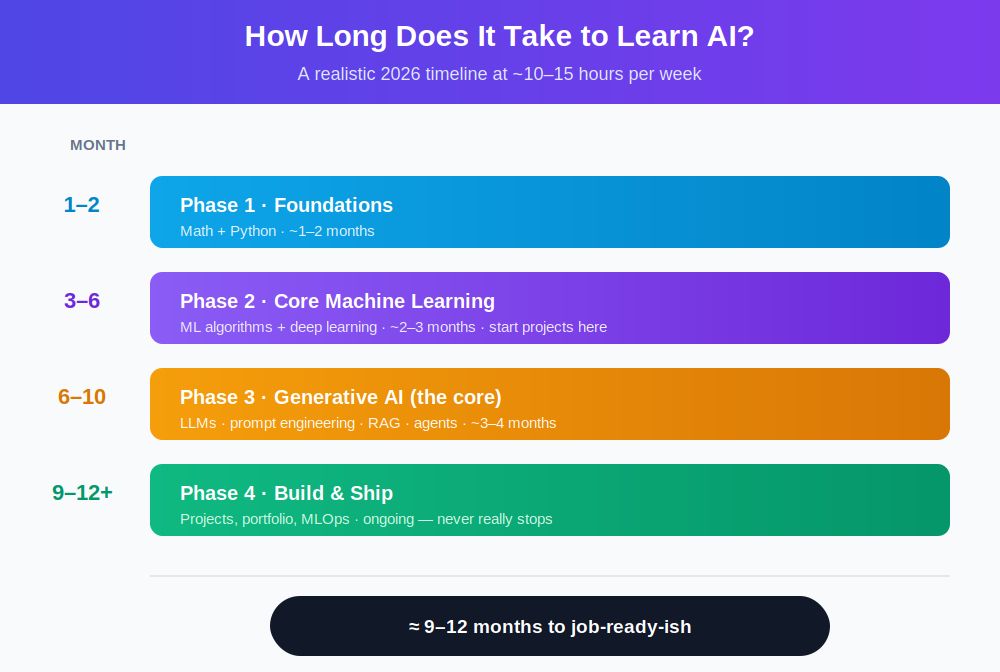
If you study seriously, around 10 to 15 hours a week, the foundations and core ML take roughly 4 to 6 months. The generative AI phase takes another 3 to 4 months. And projects and deployment are ongoing, you never really stop. So a committed beginner can reach job-ready-ish in about 9 to 12 months. Faster if you already know Python or math.
But don’t treat it as a race to finish before you build. Start projects from Phase 2 onward. The people who make it are the ones who build as they learn, not the ones who wait until they’ve “finished” the roadmap, because you never really finish it.
What does an AI engineer actually do?
Quick reality check, since a lot of people follow this artificial intelligence learning roadmap without knowing what the job looks like. An AI engineer in 2026 spends a lot of time building applications with existing models rather than training new ones from scratch. So you’re designing RAG systems, building agents, integrating LLMs into products, fine-tuning where needed, and deploying and monitoring all of it. The generative-AI-heavy shape of this roadmap reflects that reality, it’s built toward the job that actually exists now, not the one from five years ago.
How AI, ML, deep learning, generative AI, LLMs, and RAG fit together
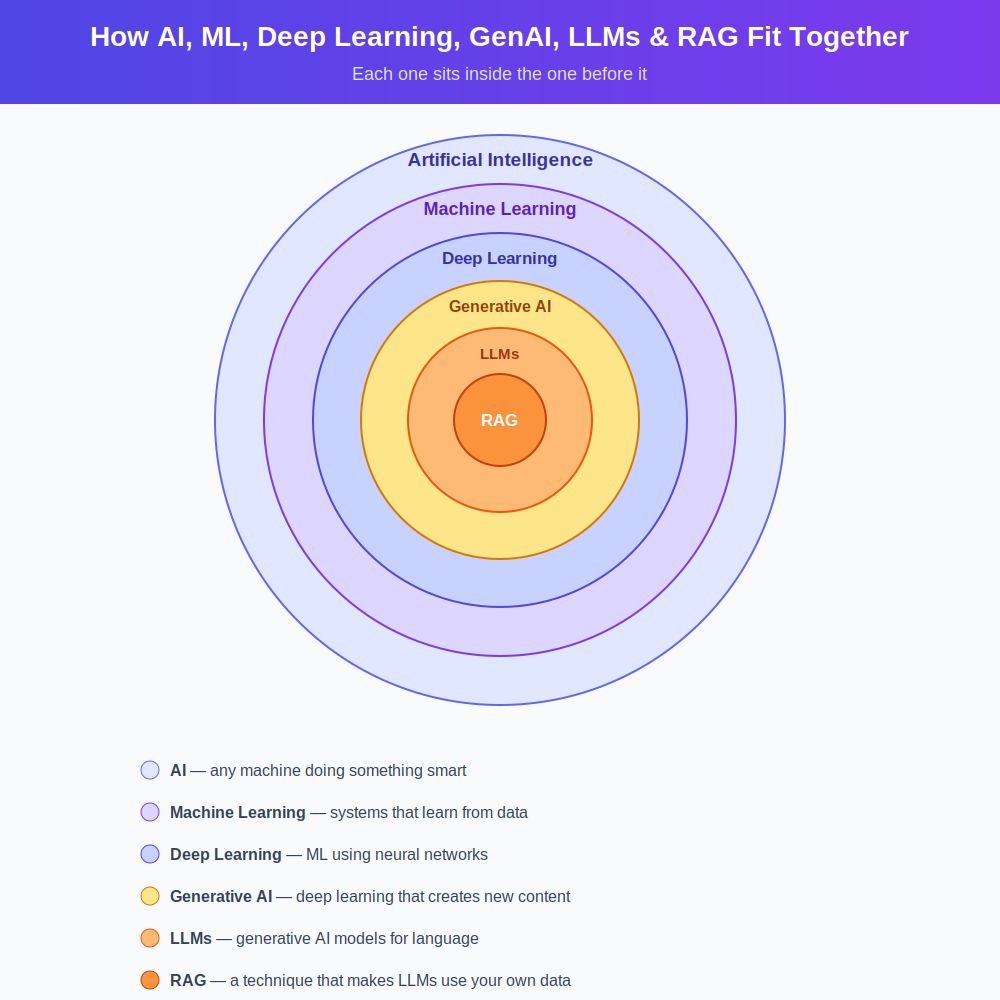
People get tangled up in these terms, so let me untangle them simply. Artificial intelligence is the big umbrella, any machine doing something smart. Machine learning is a subset of AI where systems learn from data. Deep learning is a subset of ML that uses neural networks. Generative AI is a use of deep learning that creates new content. LLMs are generative AI models for language. And RAG is a technique for making those LLMs use your own data. So they’re nested, each one sits inside the one before it, which is why the roadmap builds in that order.
Now it’s time to wrap up this Artificial Intelligence Learning Roadmap [AI Roadmap] 2026!
Conclusion
In this article, I have discussed a step-by-step Artificial Intelligence Learning Roadmap [AI Roadmap] 2026. If you have any doubts or queries regarding Artificial Intelligence Learning Roadmap, feel free to ask me in the comment section. I am here to help you.
So that’s the complete AI learning roadmap for 2026. Foundations, core machine learning, generative AI at the center, and then building and shipping real projects. The biggest thing to take from it is the reordering, generative AI, LLMs, RAG, and agents are the heart of the path now, and big data and BI are optional side-tracks, not blockers.
Start with the foundations, don’t wait until you feel ready to build, and follow the phases in order. If you do the work, 2026 is a genuinely great time to enter this field.
If you found this roadmap helpful, or you’re on the journey and want to share where you’re at, drop a comment. I read and reply to every one, and I love hearing how people are progressing.
All the Best for your Career!
Happy Learning!
FAQ on Artificial Intelligence Learning Roadmap
You May Also Be Interested In
Best Resources to Learn Computer Vision (YouTube, Tutorials, Courses, Books, etc)- 2026
Best Certification Courses for Artificial Intelligence- Beginner to Advanced
Best Natural Language Processing Courses Online to Become Expert
Best Artificial Intelligence Courses for Healthcare You Should Know in 2026
What is Natural Language Processing? A Complete and Easy Guide
Best Books for Natural Language Processing You Should Read
Augmented Reality Vs Virtual Reality, Differences You Need To Know!
What are Artificial Intelligence Examples? Real-World Examples.
Thank YOU!
Explore more about Artificial Intelligence.
Thought of the Day…
‘ It’s what you learn after you know it all that counts.’
– John Wooden

Written By Aqsa Zafar
Aqsa Zafar is a Ph.D. scholar in Machine Learning at Dayananda Sagar University, specializing in Natural Language Processing and Deep Learning. She has published research in AI applications for mental health and actively shares insights on data science, machine learning, and generative AI through MLTUT. With a strong background in computer science (B.Tech and M.Tech), Aqsa combines academic expertise with practical experience to help learners and professionals understand and apply AI in real-world scenarios.